Stargaze app is a Cosmos NFT trading interface priced around ATOM collections
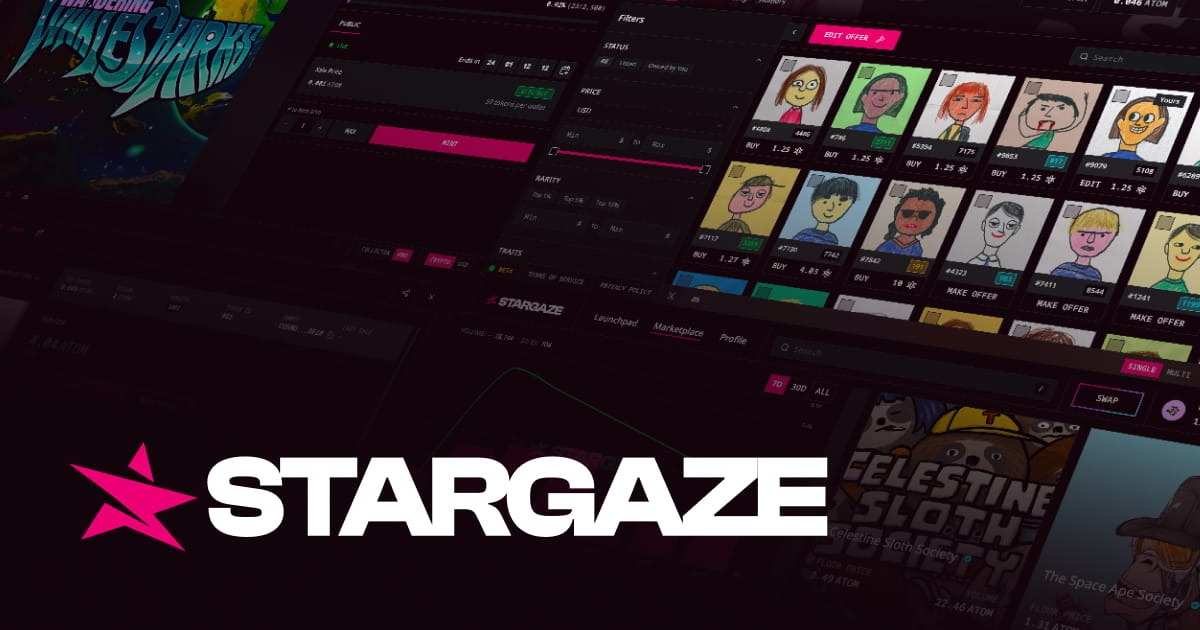
Stargaze app is a Cosmos NFT marketplace interface for browsing collections, checking ATOM floor prices, making offers, minting launchpad drops, and following live collection activity. It brings marketplace trading, launchpad discovery, analytics, swap access, and search into one app-shaped experience for users who want Cosmos-native NFTs without leaving the ecosystem. The main draw is practical: collection pages show floor price, best offer, sales, thirty-day volume, items for sale, owner counts, and chart data in terms that NFT buyers already understand.
The marketplace view starts with collection liquidity
The first useful screen is not a slogan; it is a market board. Featured and trending collections show floor price in ATOM, the strongest offer, recent sales, volume over the last thirty days, how many tokens are listed, and how many owners hold the collection. That layout suits collectors who compare liquidity before they click into art, rarity, or community lore.
Names such as Bad Kids, Celestine Sloth Society, GATA Pixels, Mad Scientists, and Underworld Necropolis show the type of Cosmos-native inventory people expect to see. The numbers beside those collections matter because they separate an active market from a quiet gallery. A floor without offers tells a different story than a floor with steady sales, and Stargaze app puts those signals close together.
How ATOM pricing changes the buying flow
ATOM-denominated pricing gives the marketplace a familiar base asset for Cosmos users. A buyer reads a floor as "95 ATOM" or "8.60 ATOM" and compares it with the wallet balance used across the wider Cosmos ecosystem. Dollar estimates add a second reference point, but the decision still revolves around the on-chain asset used to bid, list, and settle the trade.
This matters during fast-moving mints and collection sweeps. When the interface displays both floor price and best offer, the gap between sellers and bidders becomes visible before a user opens a token page. A narrow gap points to more efficient trading; a wide gap signals that sellers and buyers disagree on value. Stargaze app uses those market fields to make NFT pricing less opaque.
Launchpad mints belong beside secondary trading
The Launchpad section is where new projects move from announcement to mint. A collector who wants fresh supply watches minting pages, checks the collection premise, reviews the visible supply mechanics, and decides whether to participate before the secondary market forms. Keeping Launchpad next to Marketplace also gives finished mints a natural path into trading once tokens start changing hands.
For creators, the same surface supports the public side of a launch: project presentation, mint timing, collection visibility, and later marketplace access. A strong drop still needs artwork, community demand, and clean execution, but the app gives a Cosmos NFT project a recognizable storefront instead of sending users through disconnected tools.
Collection pages turn scattered signals into a trade screen
A useful collection page answers several questions at once. How much does the cheapest listed item cost? What are buyers offering? Are sales happening this week? How much supply is actually for sale? How concentrated is ownership? Stargaze app places those details where a collector can scan them before committing wallet approval.
The same page also supports slower research. Owner percentage, listed supply, thirty-day volume, and sales count help distinguish a thinly traded profile-picture set from a collection with recurring demand. Descriptions add context, but market behavior carries weight. A funny tagline or ambitious utility pitch gains credibility only when listings, bids, and volume support attention.
Offers, floors, and sales tell different stories
Floor price is the visible entry point, not the whole market. Best offer shows the strongest immediate demand. Sales show completed transactions rather than asking prices. Thirty-day volume shows whether activity is concentrated in one burst or spread across recent weeks. Read together, those fields help a buyer avoid treating a stale listing as a reliable price.
- Floor price shows the lowest current ask in ATOM.
- Best offer shows the strongest bid available to sellers.
- Sales count shows how many tokens actually changed hands.
- Thirty-day volume shows recent trading depth.
- For-sale supply shows how much of the collection is liquid.
That combination is especially helpful on collections with unusual supply profiles. A set with thousands of tokens and low listed supply behaves differently from a smaller set where many owners list at once. The dashboard format keeps the comparison concrete.
Wallet connection is the bridge from browsing to action
Browsing does not require much commitment, but buying, minting, listing, and making offers require a Cosmos wallet. Keplr and Leap are common wallet choices in this ecosystem because they handle Cosmos accounts, transaction prompts, and asset balances in a familiar browser or mobile flow. Once connected, the wallet signs marketplace actions and displays the transaction details before submission.
New users should fund the correct account before trying to mint or buy. They also need enough ATOM for the purchase itself and enough balance for network costs. The important caution is operational: confirm the collection name and token details on the transaction prompt before signing, because NFT trades settle on-chain once the wallet approves them.

Analytics make the app useful after the first purchase
The Analytics area turns Stargaze app into more than a checkout page. Collection charts, recent activity, volume rankings, and trending screens help holders follow demand after mint day. That is where a user notices whether a collection is gaining owners, losing momentum, or trading in short bursts around announcements.
Collectors who hold several Cosmos NFTs use those signals for portfolio maintenance. They watch the best-offer line when deciding whether to accept a bid, scan floor changes before listing, and compare thirty-day activity across collections. The app's structure favors repeat checking because each metric is tied to a visible action: bid, buy, list, hold, or mint.
Swap and search reduce friction around NFT trading
The presence of Swap and Search in the navigation matters because NFT trading rarely starts with one clean path. A user searches a collection by name, checks activity, realizes the wallet needs a different balance, swaps assets, then returns to make an offer or buy from the floor. Stargaze app keeps those steps close enough that discovery and execution feel connected.
Search also matters for avoiding lookalike confusion. Collection names, token pages, and marketplace filters give users a direct route to the asset they meant to inspect. On a chain where multiple collections borrow similar themes, a precise search flow saves time and reduces mistaken clicks.
Where it fits among Cosmos NFT tools
Within Cosmos, the marketplace works as the NFT front door for collectors who already understand IBC assets, wallet approvals, and app-chain activity. It is different from general multi-chain NFT sites because the experience centers on Cosmos collections and ATOM-denominated market data. It also differs from a pure minting site because secondary-market liquidity, offers, and analytics remain prominent after launch.
Alternatives exist in the wider NFT market, including OpenSea for broad EVM and cross-chain inventory, Magic Eden for major retail NFT flows across several networks, and Tensor for a Solana-heavy trading style. A Cosmos user comes to Stargaze app for native collection discovery, launchpad mints, and marketplace data that matches the assets already used in the Cosmos wallet.
Who gets the most value from the interface
The strongest fit is a user who wants to stay inside Cosmos while evaluating NFT collections with real market data. Traders get floor, offer, and volume fields. Collectors get artwork, descriptions, ownership numbers, and collection pages. Creators get a launch surface connected to the marketplace where buyers already browse new mints.
Stargaze app also suits users who care about the path from primary mint to secondary trade. A project can appear in minting activity, graduate into marketplace listings, and build a visible chart history. That continuity is the reason the app feels more like a full NFT venue than a single-purpose mint page.
Before you start with Stargaze app
- Fees on Stargaze app NFT trades: what should buyers expect?
- A buyer should expect the listed NFT price in ATOM plus the network cost shown in the wallet confirmation. The marketplace interface displays the collection price and offer data, while the wallet prompt shows the transaction details before signing. Collection-specific royalties or marketplace charges are part of the final trade flow when they apply to a listed item.
- Which collection metrics matter most before making an ATOM offer?
- The most useful metrics are floor price, best offer, sales count, thirty-day volume, listed supply, and owner count. Floor price shows the cheapest current ask, while best offer shows buyer demand. Sales and volume confirm whether trades are closing. Listed supply and owner count help show whether liquidity is broad or concentrated.
- Can creators launch a new Cosmos NFT collection through Stargaze app?
- The Launchpad area is built for new NFT projects that want a public mint path inside the Cosmos NFT ecosystem. Creators use it to present a collection and bring minting into the same environment where collectors already browse marketplace activity. A launch still depends on project setup, artwork, supply design, and demand from buyers.
- Is ATOM the only asset shown for Stargaze app collection prices?
- The main marketplace presentation emphasizes ATOM pricing for floor prices, best offers, and volume, with dollar estimates shown beside many figures. That gives Cosmos users a consistent base for comparing collections. Wallet balances and swap needs still depend on the asset required by the specific transaction flow at the moment of purchase or mint.
- Recovering a failed mint transaction in Stargaze app: what should I check first?
- First check the wallet activity and the collection page before trying again. A failed mint commonly comes from insufficient balance, a rejected wallet prompt, network congestion, or a mint phase that ended before the transaction settled. If no NFT appears and no successful transaction is recorded, the user can correct the issue and submit a fresh transaction.