Stargaze is a Cosmos NFT launchpad organized around ATOM-priced collection discovery
Stargaze is a Cosmos NFT marketplace and launchpad where collectors review ATOM floor prices, compare best offers, follow 30-day volume, mint new collections, and trade across live marketplace activity. The practical value is the way collection pages, analytics, minting, offers, and wallet actions meet in one Cosmos-native workflow, so a buyer or project team sees market depth before committing capital.
Reading ATOM floors before you click buy
The strongest alternate angle on this marketplace is price discovery. Collection rows expose the numbers that matter at the point of decision: floor price, best offer, recent sales, 30-day volume, listed supply, owner count, and ownership concentration. Those fields let a user separate a thin listing from an active market before opening an individual NFT.
ATOM pricing also gives Cosmos users a familiar accounting unit. A floor of 95 ATOM on Bad Kids tells a different story from a 1.75 ATOM floor on Underworld Necropolis, and the difference is more useful when paired with volume and sales counts. A low floor with many owners points to a broad collector base; a high floor with limited turnover needs more patience.
The launchpad workflow from mint page to secondary listing
Stargaze connects primary minting and secondary trading more tightly than a generic gallery. A collection launches, buyers mint from the launchpad, and the same asset class then appears in marketplace views where floor and offer data start forming. Project teams get a Cosmos-native mint venue, while collectors get a direct path from new supply to resale liquidity.
A mint decision starts with supply, artwork, team reputation, community signals, and the stated use of funds. After minting, the owner manages the NFT from a compatible Cosmos wallet and chooses whether to hold, list, or accept an offer. The transition from launchpad to marketplace matters because the first visible trades set expectations for the collection's early market.
Marketplace analytics that shorten collection research
Analytics on Stargaze are built around the questions collectors ask during a short research session. Which collections traded today? Which floors moved? Where are bids clustered? How many pieces are listed? Those answers sit near the marketplace surface instead of requiring a separate spreadsheet or block explorer session.
Thirty-day volume deserves special attention because it filters out single-sale noise. A collection with a rising floor and meaningful 30-day volume shows stronger market participation than a collection with one expensive listing and no fresh demand. Best-offer data adds another layer because bids reveal where buyers are actually willing to meet sellers.
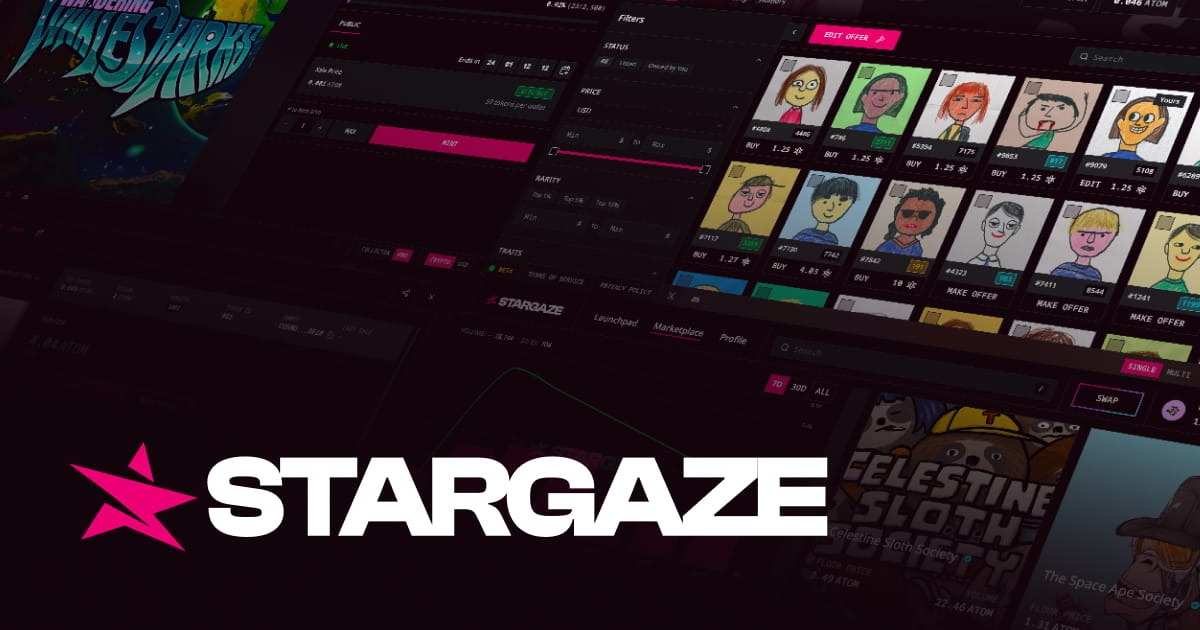
Featured collections as a starting map, not a finish line
Featured and trending areas help new visitors orient themselves, especially when recognizable names such as Bad Kids, Mad Scientists, Lost Cosmonauts, Celestine Sloth Society, and GATA Pixels appear near the top of activity pages. These sections surface the collections people are currently watching, but the better research comes from opening each collection and reading its own trading pattern.
Descriptions still matter. Some collections exist as profile-picture art, some attach reward mechanics, some emphasize community membership, and others experiment with storage, DeFi access, or creator tooling. A collection's floor only tells the cheapest listed entry; its stated purpose explains why holders value the asset beyond a sale chart.
Offers, listings, and the spread between them
The gap between floor price and best offer is one of the cleanest signals on the page. When the best offer sits close to the floor, sellers have an obvious exit level and buyers are competing near current listings. When the spread is wide, the visible floor shows seller ambition more than executable demand.
For context, Stargaze makes that spread easier to read because both values appear together in ATOM. A buyer considering a collection does not need to translate between bid currency and list currency. The decision becomes direct: accept the current ask, place an offer, or wait for new listings that better match recent sale history.
Wallet setup and the first purchase path
A first purchase begins with a Cosmos wallet that supports the network and enough ATOM for the NFT price plus transaction fees. The user connects the wallet, searches or browses collections, opens a specific item, reviews the listing terms, and signs the transaction from the wallet prompt. The asset then appears under the connected address after settlement.
Search is useful when the collection name is already known; featured and trending sections are better when the user is still exploring. New buyers should slow down on names that look visually similar to known collections, because copied artwork and confusing naming are a real marketplace risk. Exact collection pages and contract-level provenance carry more weight than a familiar thumbnail.

How creators use Cosmos-native minting
For creators, Stargaze provides launch infrastructure in the ecosystem where many collectors already hold ATOM and use Cosmos wallets. The launchpad handles the public mint surface, and the marketplace gives the collection an immediate secondary venue once items circulate. That reduces friction between a primary drop and the first resale market.
Collection teams still carry the hard work: art direction, mint structure, communication, utility design, treasury planning, and post-mint delivery. The launch venue supplies the rails, not the community. A clean mint page and active secondary market help discovery, but lasting demand comes from credible execution after the initial sale.
Where swap access fits into the NFT flow
The presence of swap navigation reflects a practical truth of Cosmos NFTs: users arrive with different assets and need the right token before they can mint or buy. If a wallet holds another Cosmos asset, a swap path helps prepare balances without leaving the broader workflow. That matters most during active mints, when speed and clean wallet balances reduce failed attempts.
On a practical level, Stargaze also benefits from Cosmos interoperability because collectors already move between Osmosis, Cosmos Hub assets, and app -specific chains. NFT trading remains the focus, but token movement and marketplace readiness are part of the same user journey. A buyer who checks liquidity before a mint spends less time reacting under pressure.
Alternatives for collectors who need a different market
Cosmos NFT buyers sometimes compare this market with chain-specific venues and broad marketplaces on Ethereum, Solana, or Bitcoin Ordinals. OpenSea gives wider multi-chain exposure, Magic Eden has deep Solana and Bitcoin activity, and Tensor focuses on fast Solana trading tools. Stargaze is more focused: it serves Cosmos-native collections, ATOM-denominated discovery, and launchpad activity inside that ecosystem.
That focus is the reason it works well for a certain type of collector. Someone tracking Cosmos cultural assets, STARS community activity, or ATOM-priced NFT liquidity gets cleaner context than on a marketplace dominated by unrelated chains. Someone chasing the deepest global NFT liquidity will still monitor larger venues, but Cosmos-specific collection research belongs closer to the chain where the assets live.

The practical edge of one screen with floors, offers, and volume
That said, Stargaze earns attention when the user treats the marketplace as a decision dashboard rather than a simple image feed. Floor price gives the entry point, best offer shows current demand, sales count confirms turnover, and 30-day volume shows whether interest persists beyond a single transaction. Together, those fields turn NFT browsing into structured collection research.
The same information helps sellers. A holder can compare the lowest listing with recent bids, then decide whether to undercut, match the market, or wait. Creators can watch how their collection performs after mint, and collectors can decide whether new liquidity justifies another purchase. In a market where taste, timing, and liquidity all matter, the dashboard view is the real feature.
Stargaze - common questions
Fees on Stargaze marketplace purchases are paid in which asset?
Marketplace purchases are priced in ATOM on the visible collection tables, and buyers need enough wallet balance to cover the listed NFT price plus the network transaction fee required to sign and settle the purchase. The exact fee shown in the wallet prompt changes with network conditions and the action being signed, so the final confirmation screen is the place to review the total before approval.
Can a collection have volume but a weak best offer?
Yes. Volume records completed trades over a period, while the best offer shows the strongest current bid visible in the market. A collection can show meaningful 30-day volume from earlier sales and still have a low current bid if buyer demand cooled or sellers raised floors above where bidders want to transact.
Which Stargaze numbers matter most before listing an NFT?
The most useful listing inputs are current floor price, best offer, recent sales, listed supply, and 30-day volume. Floor price shows the cheapest competing ask, best offer reveals the immediate exit level, and recent sales show where transactions actually cleared. Listed supply matters because a crowded floor creates more competition among sellers.
Is ATOM floor price the same as the value of every item in a collection?
No. The ATOM floor price is the lowest visible listing for that collection at a given moment. Individual NFTs trade above or below that reference based on traits, rarity, aesthetics, provenance, and seller urgency. Floor price is useful for tracking the cheapest entry point, but it does not price rare items or negotiated offers precisely.
Recovering access if a wallet disconnects during browsing
A disconnected wallet does not remove NFTs from the address; it only breaks the browser session connection. Reconnect the same wallet account to view owned assets and continue marketplace actions. If a different account is selected inside the wallet, the marketplace will show that other address instead, which is a common reason holdings appear missing.