Stargaze is a Cosmos NFT marketplace where ATOM-priced collections move from mint to secondary offers
Stargaze is a Cosmos NFT marketplace for browsing collections, minting new drops, placing offers, and tracking trading activity in ATOM. It serves collectors who want a native Cosmos venue rather than a general NFT site, with launchpad pages for primary sales, marketplace listings for secondary trades, and analytics that show floor price, best offer, sales, owners, supply for sale, and recent volume.
ATOM pricing gives collectors a common market language
The marketplace experience is built around collection-level data that collectors already use to judge liquidity. A collection page surfaces the floor price, the highest active offer, sales over a recent window, volume, listed supply, owner count, and chart activity. Those numbers matter because NFT markets are thin by design: one sale changes a floor, one accepted offer clears a bid, and one new mint can redirect attention across the chain.
Using ATOM as the visible pricing unit also makes the venue easier to read for people already active in the Cosmos ecosystem. A buyer sees a floor quoted in the same asset used across many Cosmos apps, while a seller sees offers expressed without translating every listing into a separate collection token. Dollar equivalents help with orientation, but the market conversation remains centered on the chain-native asset that buyers actually deploy.
What happens on the marketplace screen
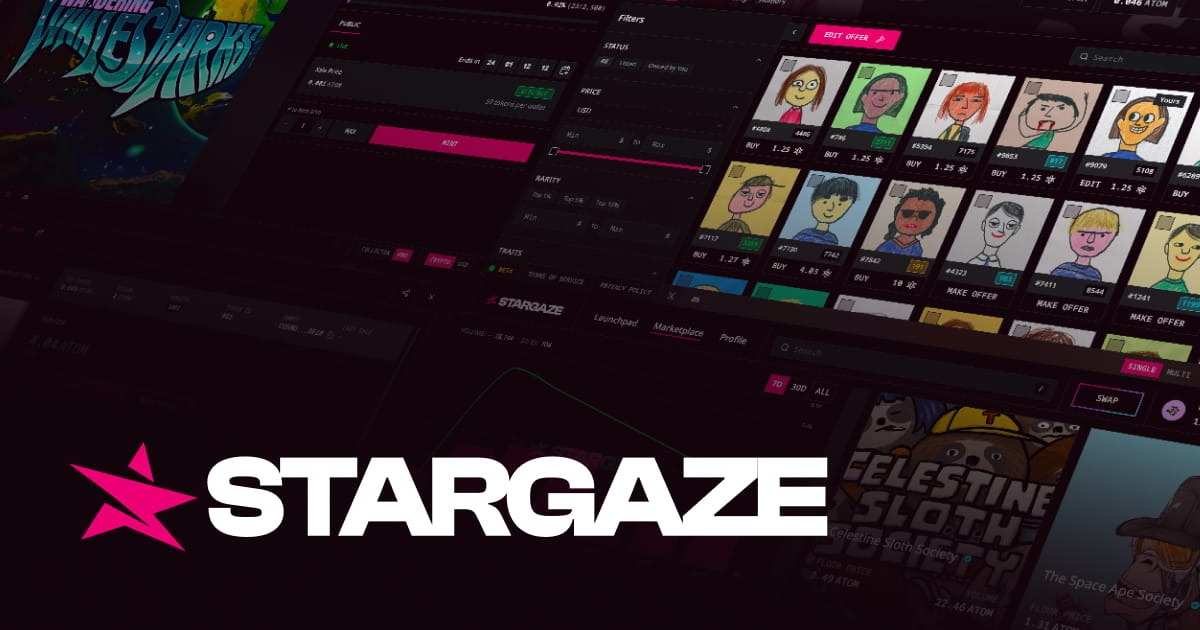
The main marketplace view works like a live trading board for NFTs. Featured collections highlight notable projects, trending tables rank activity, and latest activity shows the market's current pulse. Collection cards pull together floor, volume, offer depth, and ownership data, so a user gets a quick picture before opening a project page.
On Stargaze , the secondary market depends on listings and offers rather than a single automatic price curve. Sellers list individual NFTs at chosen prices. Buyers either purchase a listed item or place an offer that the owner accepts, rejects, or ignores. That offer-based flow matters for collectibles because rarity, traits, collection culture, and current demand produce wide price differences inside the same project.
Launchpad drops turn primary minting into a Cosmos-native workflow
The launchpad is the primary sale side of the product. Instead of only finding NFTs after the initial mint, users see projects that are minting right now or preparing for a drop. A creator sets up a collection, publishes mint details, and directs early buyers to a mint page where wallet transactions create new NFTs on the chain.
This is a different rhythm from secondary trading. During a mint, the key questions are supply, mint price, timing, reveal mechanics, wallet eligibility, and the creator's track record. After the mint, attention shifts to floor formation, owner distribution, sales count, and how much of the collection is listed. Stargaze brings both stages into the same destination, which helps a project move from launch to open trading without sending its community to a separate venue.
Analytics make collection momentum easier to read
Collection analytics give shape to a market that otherwise feels like a stream of isolated images. Floor price shows the lowest current listing, best offer shows the strongest bid, and 30-day volume reflects how much trading has actually cleared. Owner count and percentage listed reveal whether the supply is widely held or sitting on the market waiting for buyers.
Those signals work best when read together. A rising floor with very few sales says something different from a steady floor with deep bid activity. High volume with a falling floor points to active repricing, while a low listed percentage suggests holders are reluctant to sell at current levels. The tables on Stargaze support that kind of reading without forcing the user to assemble the basic data by hand.
How a first purchase normally flows
A new user starts by connecting a Cosmos wallet, funding it with the assets needed for the transaction, and choosing a collection from the marketplace or launchpad. The wallet remains central because NFT ownership, bid approvals, purchases, and mints settle through signed transactions. The site presents the action, while the wallet confirms what the account is about to do.
A practical first run looks like this:
- Open a collection and compare floor price, best offer, listed supply, and recent activity.
- Inspect the individual NFT traits, media, owner history, and asking price.
- Buy a listed item when the price is acceptable, or place an offer below the ask.
- Use the launchpad area when the goal is a fresh mint instead of a resale.
- Keep enough network-fee balance in the wallet before signing marketplace actions.
Once the purchase or mint confirms, the NFT appears under the connected wallet's ownership. If the owner wants to sell later, they create a listing. If they want to test demand without listing, they watch incoming offers and market activity.
Creator pages connect art, community, and market data
For creators, the strongest part of the venue is the way discovery and trading live beside each other. A project does not only need a mint button; it needs a collection identity, supply information, post-mint visibility, and a place where holders trade without losing the context of the drop. Marketplace pages display that context through descriptions, activity, and live pricing.
Stargaze also gives creators a Cosmos audience that already understands wallets, IBC assets, and on-chain ownership. That audience is narrower than the broadest Ethereum or Solana NFT markets, but it is more aligned with ATOM liquidity and Cosmos-native community behavior. For many projects, that alignment is the point: the collection launches where its intended collectors already spend time.

Bad Kids, Mad Scientists, and other collections show the range
Visible collection data shows a mix of established profile-picture projects, art drops, experimental NFT mechanics, and DeFi-adjacent communities. Bad Kids has been one of the better-known Cosmos NFT names, while collections such as Mad Scientists, GATA Pixels, Lost Cosmonauts, and Underworld-themed projects show how different communities use the same trading surface.
The variety matters because NFT marketplaces do not become useful from software alone. They need recognizable collections, repeat buyers, active sellers, and a culture that gives assets a reason to trade. On Stargaze, the marketplace tables show that culture through actual market behavior: floors, bids, volume, and ownership concentration rather than only promotional copy.
Costs, fees, and slippage are different from fungible-token swaps
NFT trading cost is less about swap slippage and more about spread. The spread is the distance between the floor listing and the best active offer. If a floor is 21 ATOM and the best offer sits below it, the real instant-exit price is closer to the bid than the listing. A seller who needs fast liquidity accepts the strongest offer; a patient seller posts a higher ask and waits.
Network fees also apply when signing actions, and marketplace fees or creator royalties affect the final proceeds of a completed sale. The important habit is reading the confirmation screen before signing, because that screen states the asset, price, fees, and wallet action in one place. NFT transactions are easy to understand when the user slows down at the signature step.
Where it fits beside OpenSea, Magic Eden, and Cosmos apps
OpenSea serves broad Ethereum and multi-chain NFT demand, while Magic Eden became strongly associated with high-throughput NFT trading across Solana and other networks. Stargaze is more specific: it is built for Cosmos-native NFT discovery, ATOM-denominated pricing, and launchpad activity that belongs inside that ecosystem.
That specificity is a strength when a collector already uses Cosmos wallets and wants NFT exposure without leaving the network's familiar account model. It is less useful for someone searching only for Ethereum blue chips or Solana-native gaming assets. The best alternative depends on where the collection lives, which wallet the buyer uses, and which marketplace has the deepest real bids for that asset.
The main risks come from market liquidity and collection quality
NFTs are indivisible collectibles, so liquidity changes quickly. A collection can show active volume one week and quiet books the next. Floors move when sellers undercut each other, and a best offer can disappear before an owner decides to accept it. The market interface supplies useful numbers, but it does not turn a thin collectible market into a deep order book.
Project quality is the other major variable. Artwork, storage choices, team execution, community durability, and post-mint delivery all influence whether a collection keeps attention after launch. A strong listing page and attractive floor are only part of the picture; the collection's actual demand decides whether the asset remains easy to sell.
Why the Cosmos focus is the reason people use it
The clearest reason to use Stargaze is the combination of Cosmos wallet compatibility, ATOM-priced marketplace behavior, launchpad mints, and collection analytics in one NFT venue. It gives collectors a focused place to watch floor action, find current mints, place bids, and follow communities that grew inside the Cosmos network.
That focus also keeps the product understandable. The app does not try to be every NFT marketplace at once. It gives Cosmos users the core actions they need: discover a collection, read its market, mint when a drop is live, buy or bid on individual NFTs, and manage ownership through a self-custodied wallet.
Stargaze questions worth asking
Do I need ATOM to buy NFTs on Stargaze?
ATOM is the main visible pricing unit for many marketplace listings and offers, so buyers commonly need ATOM available in a compatible Cosmos wallet. The wallet also needs enough balance for the network transaction fee required to sign the purchase, bid, mint, or listing action. The exact asset shown in the transaction preview is the one the wallet will spend.
Which wallets work best with a Cosmos NFT marketplace?
Cosmos-focused wallets such as Keplr and Leap are the natural choices because they support Cosmos accounts, transaction signing, and assets used across the ecosystem. The right wallet is the one that connects cleanly to the app, shows the intended account, and presents readable transaction details before signing. Hardware wallet support depends on the wallet setup and the action being signed.
Can creators launch a collection directly through the site?
Creators use the launchpad side of the product to prepare and run NFT drops for a Cosmos audience. A launch involves collection metadata, mint configuration, sale timing, supply details, and a page where buyers sign mint transactions. After minting, the same collection enters the secondary marketplace, where holders list assets and buyers place offers.
What happens if my NFT listing receives an offer below the floor price?
An offer below the floor price is simply a bid from a buyer who wants a lower entry point. The owner decides whether to accept it, leave it open, or ignore it. Accepting the offer trades speed for price certainty, while keeping a listing active leaves the NFT available at the seller's chosen ask.
Fees on Stargaze: what should sellers look at before listing?
Sellers should look at the listed price, marketplace fee, creator royalty if one applies, and the network fee for signing the transaction. The confirmation flow shows the concrete action before it is submitted. The more important market cost is the bid-ask gap: a high floor does not matter much if the best active offer sits far below it.
Is a launchpad mint different from buying an NFT from another owner?
Yes. A launchpad mint creates or distributes a new NFT during the collection's primary sale, while a marketplace purchase transfers an existing NFT from a current owner. Minting focuses on sale rules, supply, price, and timing. Secondary buying focuses on traits, listing price, collection activity, owner history, and the strength of current bids.
Why does the floor price change after a collection mints out?
The floor changes because owners start listing newly minted NFTs at different prices and buyers decide where demand actually clears. Early floors move fast when holders undercut each other, rare items get repriced, and offers begin to form under the lowest listings. A mint price shows the primary sale cost; the post-mint floor reflects live secondary-market behavior.